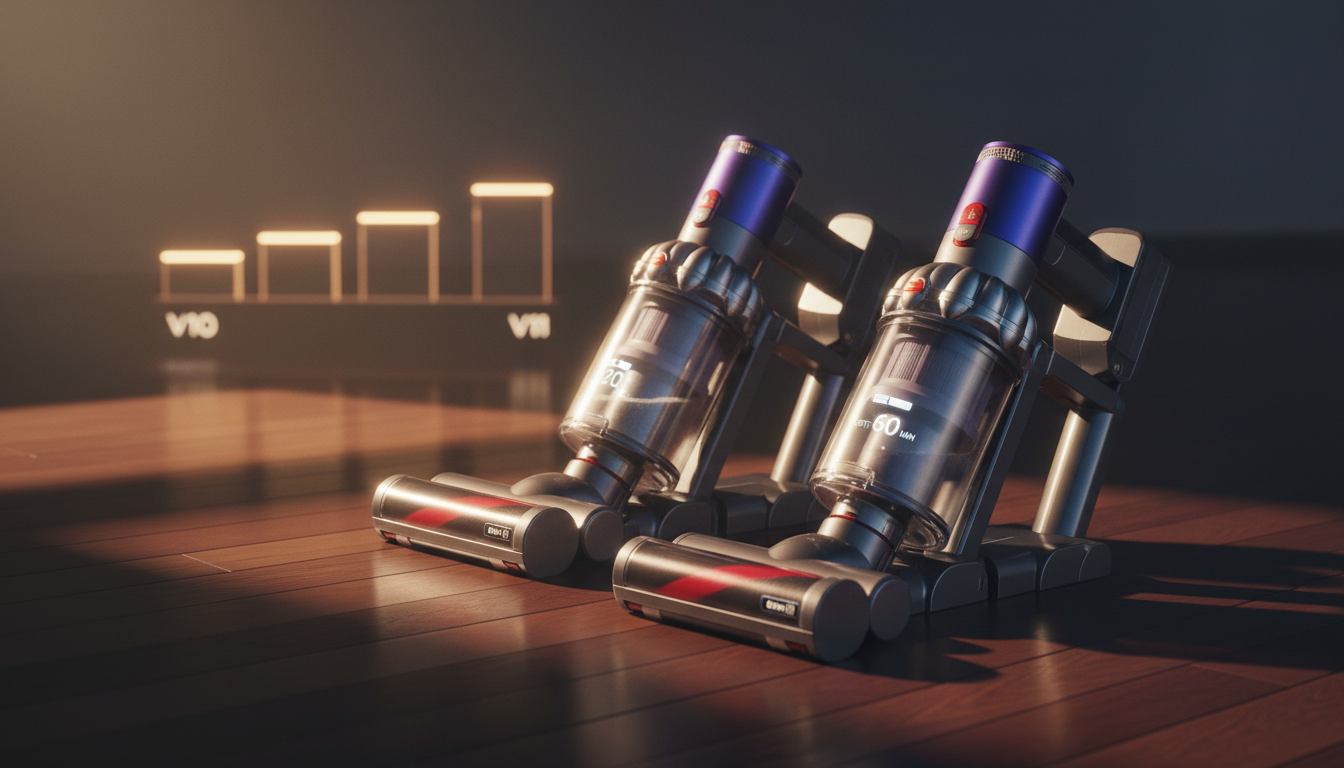
The Evolution of Cordless Endurance: Understanding the Shift
When Dyson released the Cyclone V10, it represented a paradigm shift in the floorcare industry. Sir James Dyson famously announced that the company would stop developing corded vacuums, betting everything on the V10’s ability to provide "whole-home cleaning" power. However, the Achilles' heel of any cordless device remains its power source. In this dyson v10 vs v11 battery comparison, we look at how Dyson moved from raw power to intelligent power management.
The V10 introduced the linear "point-and-shoot" bin design, which optimized airflow and allowed for a more powerful 7-cell lithium-ion battery. This battery was designed to provide up to 60 minutes of fade-free suction in "Suction Mode 1" with a non-motorized tool. For many users, this was the first time a cordless vacuum felt like a legitimate primary cleaner. Yet, as the market evolved, the limitations of the V10's "dumb" battery became apparent. Users had to guess how much time was left based on three blinking LEDs—a primitive method that often led to the vacuum dying mid-stroke on a heavy rug.
Enter the Dyson V11. While the V10 was about the transition to cordless, the V11 was about the transition to intelligence. The V11 didn't just pack a larger battery; it introduced a system that could communicate. By integrating a microprocessor into the battery and the motor, the V11 became the first vacuum to compare dyson battery life in real-time against the resistance of the floor surface. This "Auto Mode" changed everything. Instead of the user manually switching modes, the V11’s Dynamic Load Sensor (DLS) system monitors brush bar resistance 360 times a second, automatically adjusting motor speed and power consumption.
This background is crucial because battery life is not just about the milliamp-hour (mAh) rating; it is about efficiency. The V10 is a manual transmission vehicle—powerful but reliant on the driver to shift gears to save fuel. The V11 is an advanced automatic with regenerative braking and an onboard computer. To truly understand which one wins, we must look beyond the marketing stickers and analyze how these machines handle the brutal thermal and chemical demands of high-suction cleaning.
The Critical Problem: Thermal Degradation and Voltage Sag
The most significant challenge facing high-performance cordless vacuums is not the capacity of the battery, but the management of heat and voltage sag. When you compare dyson battery life, you are essentially comparing how each machine handles the "Boost" mode—a setting that draws massive amounts of current, heating the lithium-ion cells to their physical limits.
Lithium-ion batteries, specifically the Nickel-Cobalt-Aluminum (NCA) chemistry used in Dyson’s 7-cell packs, suffer from internal resistance. As you draw more current (Boost mode), this resistance generates heat. In the Dyson V10, the thermal management is largely passive. If you run a V10 on Max power for its full 5–7 minute duration, the battery pack becomes significantly hot to the touch. This heat causes two problems: first, it triggers the Battery Management System (BMS) to shut down the unit to prevent a fire; second, it accelerates the degradation of the electrolyte within the cells, leading to a permanent loss of capacity over time.
The "Critical Problem" for V10 users is the "Cliff Effect." Because the V10 lacks a digital countdown, users frequently over-utilize the Max mode, thinking they have more "juice" than they do. This leads to frequent deep discharges. Lithium-ion batteries prefer "shallow cycles"—using 20-30% of the capacity and then recharging. Deep discharges to 0% are "chemical trauma" for the cells.
The Dyson V11 addresses this through "Intelligent Power Management." The V11 battery is physically larger and heavier than the V10's, which provides a greater surface area for heat dissipation. More importantly, the V11's LCD screen provides a countdown timer that is accurate to the second. This psychological feedback loop solves the critical problem of user error. When a user sees they only have 2 minutes of "Boost" left but 20 minutes of "Eco," they instinctively switch modes.
Furthermore, the V11’s "Auto" mode prevents the vacuum from wasting energy on hard floors. When the DLS detects a smooth surface, it drops the RPMs, reducing current draw and keeping the battery cells within their "thermal happy zone." The V10, by contrast, runs at a constant high speed if set to Max, regardless of whether you are cleaning a plush carpet or a linoleum floor. This inefficiency is why V10 batteries often fail or show significantly reduced runtime after just 18 to 24 months of heavy use, whereas V11 batteries tend to maintain their health longer through smarter load distribution.
Methodology & Core Guide: Head-to-Head Technical Breakdown
To provide an expert-level dyson v10 vs v11 battery analysis, we must break down the specifications and the real-world performance metrics across different cleaning scenarios.
1. Battery Specifications and Chemistry
- Dyson V10: Features a 25.2V, 7-cell Lithium-ion battery. The typical capacity is approximately 2600mAh to 3000mAh depending on the specific sub-model (Motorhead vs. Absolute). It uses a screw-in design, meaning it is not intended to be swapped mid-clean.
- Dyson V11: Also a 25.2V system, but with larger, higher-capacity cells (typically 3600mAh and above). Newer V11 models (often called the V11 "Click-in") feature a red button that allows the battery to be swapped out in seconds. This effectively doubles the potential runtime if you own a second pack.
2. The "Real World" Runtime Comparison
While Dyson advertises "up to 60 minutes" for both, those numbers are achieved using non-motorized tools in the lowest power setting. Here is how they actually perform with the High Torque or Torque Drive cleaner heads:
-
Eco Mode (V11) / Suction Mode 1 (V10):
- V10: Approx. 35–45 minutes on hard floors.
- V11: Approx. 50–60 minutes on hard floors.
- Winner: V11. The higher mAh capacity gives it a 15–20% edge.
-
Medium/Auto Mode:
- V10: Approx. 20–25 minutes. (Constant power)
- V11: Approx. 25–40 minutes. (Variable power)
- Winner: V11. The Auto mode is the "secret sauce." On a mix of rugs and hard floors, the V11 manages its energy far more effectively than the V10.
-
Max/Boost Mode:
- V10: 5–7 minutes.
- V11: 8–12 minutes.
- Winner: V11. While still short, the V11’s Boost mode is nearly double the duration of the V10’s, making it much more useful for stubborn pet hair or "deep cleans."
3. Charging Profiles and Battery Health
The charging circuitry in the V11 is more sophisticated. It utilizes a "tapered charge" profile that is more aggressive in the beginning (to get you back to cleaning) and more gentle at the end (to preserve cell longevity). The V10 uses a more standard linear charging curve. Both take roughly 3.5 to 4.5 hours to charge from 0% to 100%.
4. Weight vs. Endurance Trade-off
There is a physical cost to the V11's superior battery life. The V11 battery pack is roughly 15-20% heavier than the V10's. This changes the center of gravity of the vacuum. If you have wrist issues or are cleaning high-up cobwebs, the V10’s lighter battery might actually be a benefit, despite the shorter runtime. However, for floor cleaning, the V11’s weight is supported by the cleaner head, making the battery life advantage the dominant factor.
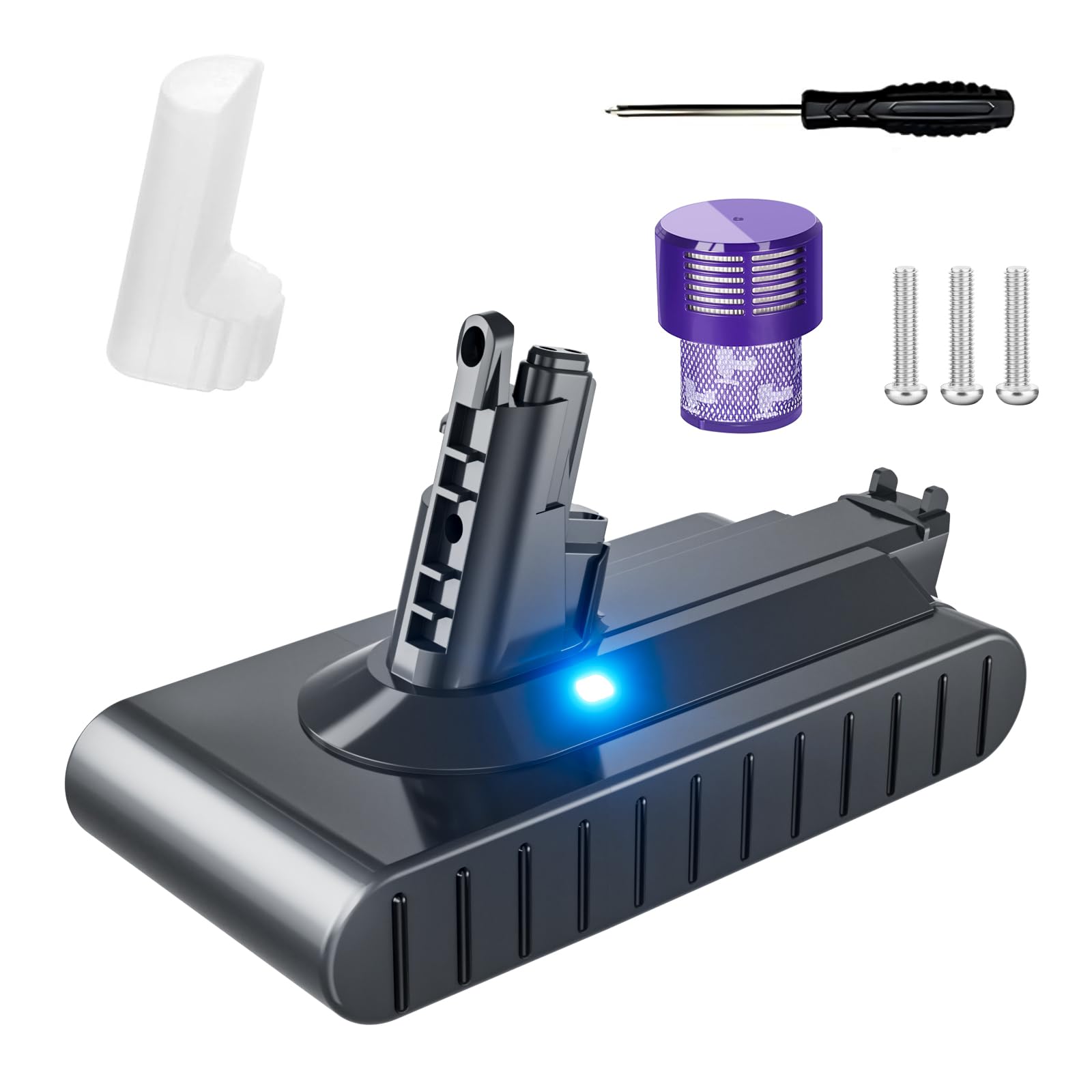
Upgraded 7000mAh V11 SV14 Battery for Dyson V11 25.2V Li-ion Battery Compatible for V11 Animal/Absol
- High-quality product
- Customer favorite
- Best value option
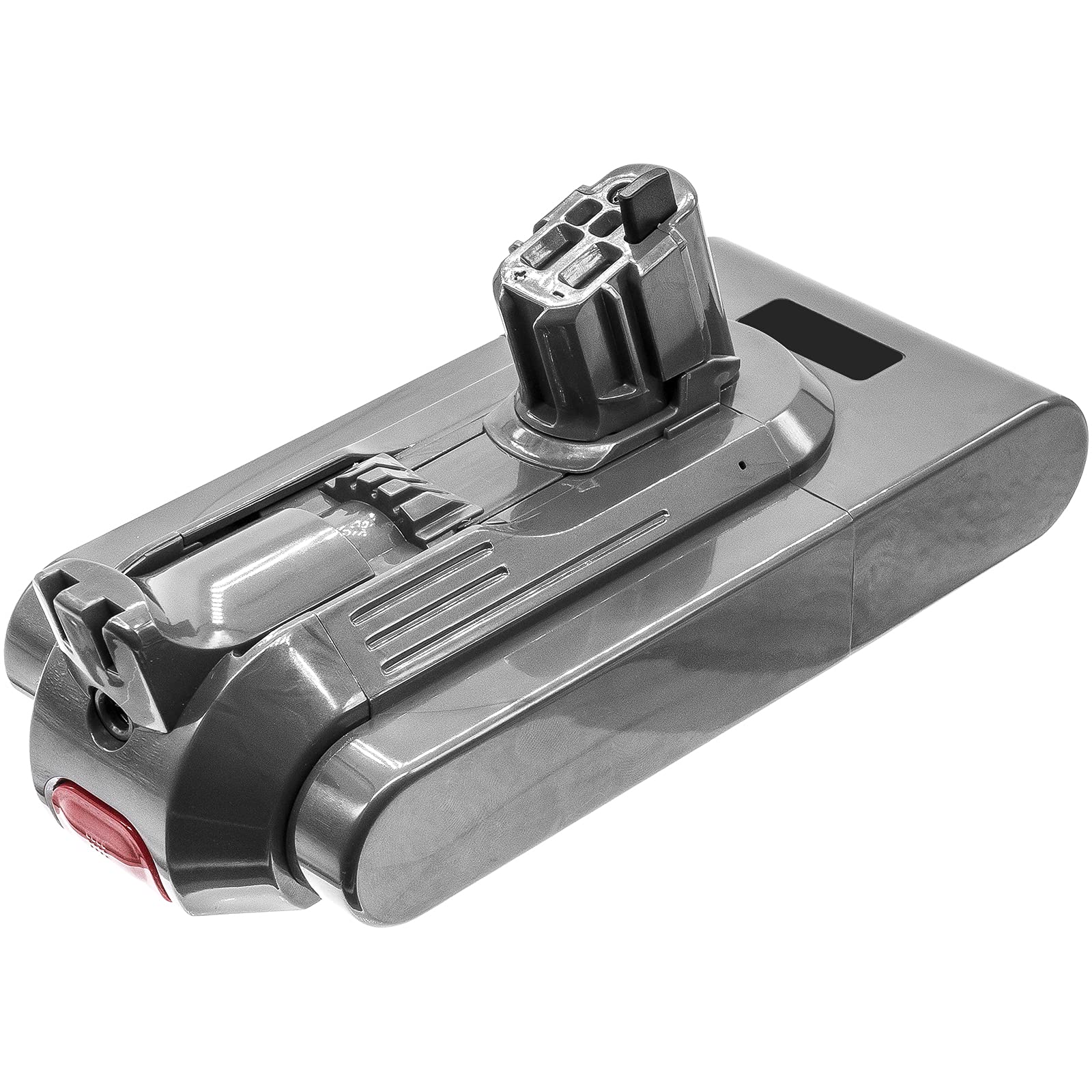
SPANN Battery Replacement for Dyson V11 Torque Size, V15 Detect Absolute Extra, V15 Detect Total Cle
- High-quality product
- Customer favorite
- Best value option
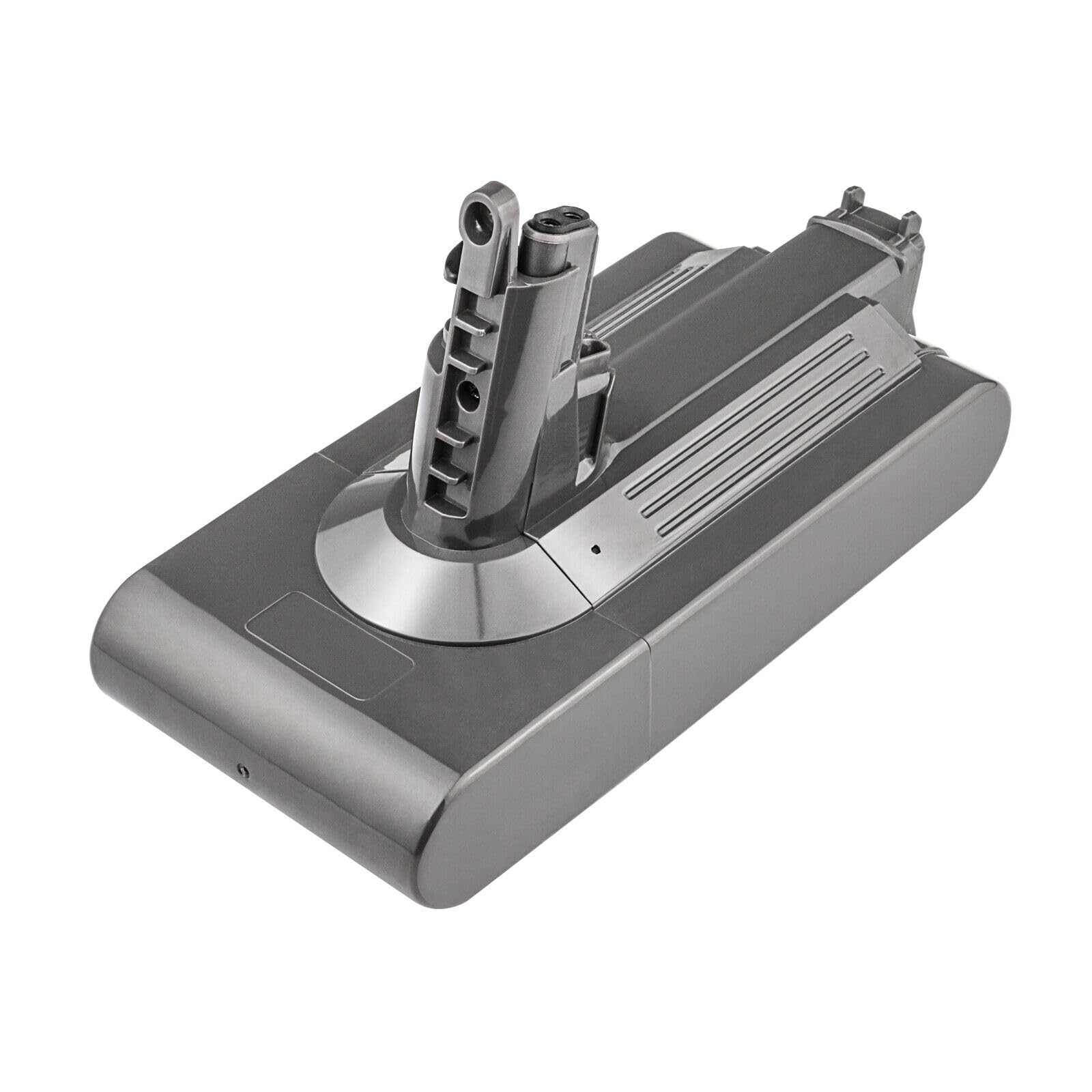
Kastar 1-Pack V1101 Battery Replacement for Dyson V11 Complete, Dyson V11 Absolute, Dyson V11 Fluffy
- High-quality product
- Customer favorite
- Best value option
Expert Hacks & Maintenance: Extending the Lifespan
Regardless of whether you choose the V10 or V11, how you treat the battery determines its ultimate lifespan. Most users treat their Dyson like a cordless drill, but the current draw is much more consistent and punishing. Here are professional-grade maintenance hacks:
1. The "80/20" Rule
Lithium-ion batteries are most stable when kept between 20% and 80% charge. While Dyson's BMS manages this to some extent, you can help. If you've only done a quick 5-minute clean, you don't have to put it back on the charger immediately. Let it sit. Conversely, if you just finished a heavy Max-mode session, let the battery cool for 30 minutes before plugging it in. Charging a hot battery is the fastest way to kill the cells.
2. Filter Maintenance = Battery Health
This is the most overlooked aspect of battery life. A clogged filter forces the motor to work harder to maintain suction. This increases the amperage draw on the battery. If your filter is dirty, your battery life will drop by 10-15% per session. Wash the filter monthly and ensure it is bone-dry (24-48 hours) before reinserting.
3. Avoid "Boost" for Routine Cleaning
On both the V10 and V11, Boost/Max mode should be reserved for "surgical strikes"—lifting a specific patch of dirt or cleaning a car's footwell. Using it for the entire house will degrade the battery's total lifecycle from 500+ charges down to perhaps 200.
4. Storage Environment
Never store your Dyson in a garage or a laundry room that gets excessively hot or cold. Extreme temperatures (below 3°C or above 35°C) will cause the chemistry in the battery to destabilize, leading to the dreaded "10-second run" followed by a red flashing light.
Mega FAQ: Everything You Need to Know
1. Can I use a V11 battery on a V10 vacuum?
No. The voltages and physical connectors are entirely different. The V11 battery is physically larger and the mounting points do not align with the V10 chassis.
2. Is the V11 "Click-in" battery better than the screw-in version?
Performance-wise, they are identical. However, the Click-in version is superior for usability because you can swap batteries if one dies. Note that early V11 models were screw-in; check your serial number before buying a replacement.
3. Why does my V11 battery life jump around on the screen?
This is normal. The V11 calculates runtime based on the current resistance. If you move from a hard floor to a thick rug, the countdown will drop instantly because the motor has to work harder.
4. How many years should a Dyson V10 or V11 battery last?
With moderate use (3-4 times a week in Eco/Auto), you should expect 3 to 5 years. Heavy use of Max mode can reduce this to 18 months.
5. Does the V11 charge faster than the V10?
No. Both take roughly 4.5 hours for a full charge. Because the V11 battery is larger, the charger actually has a slightly higher output to maintain the same charging window.
6. Can I leave my Dyson on the charger all the time?
Yes. Dyson's charging system is designed to stop drawing power once the battery is full. It will not "overcharge."
7. My V10 is pulsing. Is the battery dead?
Usually, no. Pulsing is almost always a sign of a blockage or a dirty filter. The battery is fine; the airflow is restricted.
8. What is the "Blue Light of Death" on the V10?
If the LEDs on the side of the V10 battery flash blue, it's usually a charging error. If they flash red, the battery has an internal fault and likely needs replacement.
9. Does the V11 Absolute have a better battery than the V11 Animal?
No. All V11 variants (Animal, Torque Drive, Absolute) use the same battery technology. The differences are in the included accessories.
10. Can I upgrade my V10 battery to a higher capacity?
Third-party manufacturers offer "upgraded" V10 batteries with higher mAh. While these can work, be cautious of quality; Dyson's original BMS is very specific about cell balancing.
11. Why does my V11 say "Airway Blocked" even when it's clear?
This can sometimes be a sensor glitch related to the battery not providing stable voltage to the logic board. Ensure the battery is firmly clicked or screwed in.
12. Is it worth replacing the battery or should I buy a new vacuum?
If your V10 or V11 motor is still strong, a battery replacement (approx. $100-$150) is much cheaper than a new V15 or Gen5outsize. These machines are designed to be modular.
Closing Thoughts
In the battle of dyson v10 vs v11 battery life, the V11 is the clear technological victor. It isn't just the larger capacity that wins; it is the intelligence. The ability to compare dyson battery life in real-time via the LCD screen and the automatic power adjustment of the DLS system makes the V11 a much more sustainable "whole-home" cleaner.
The V10 remains a fantastic machine for smaller homes or as a secondary vacuum, but its "dumb" battery management requires the user to be much more disciplined. If you find yourself constantly frustrated by a vacuum that dies before the job is done, the leap to the V11 (especially the Click-in model) is the single most significant upgrade you can make in the Dyson ecosystem. By following the maintenance hacks—cleaning your filters and avoiding the "Boost mode" trap—you can ensure that whichever model you choose remains a powerhouse for years to come.