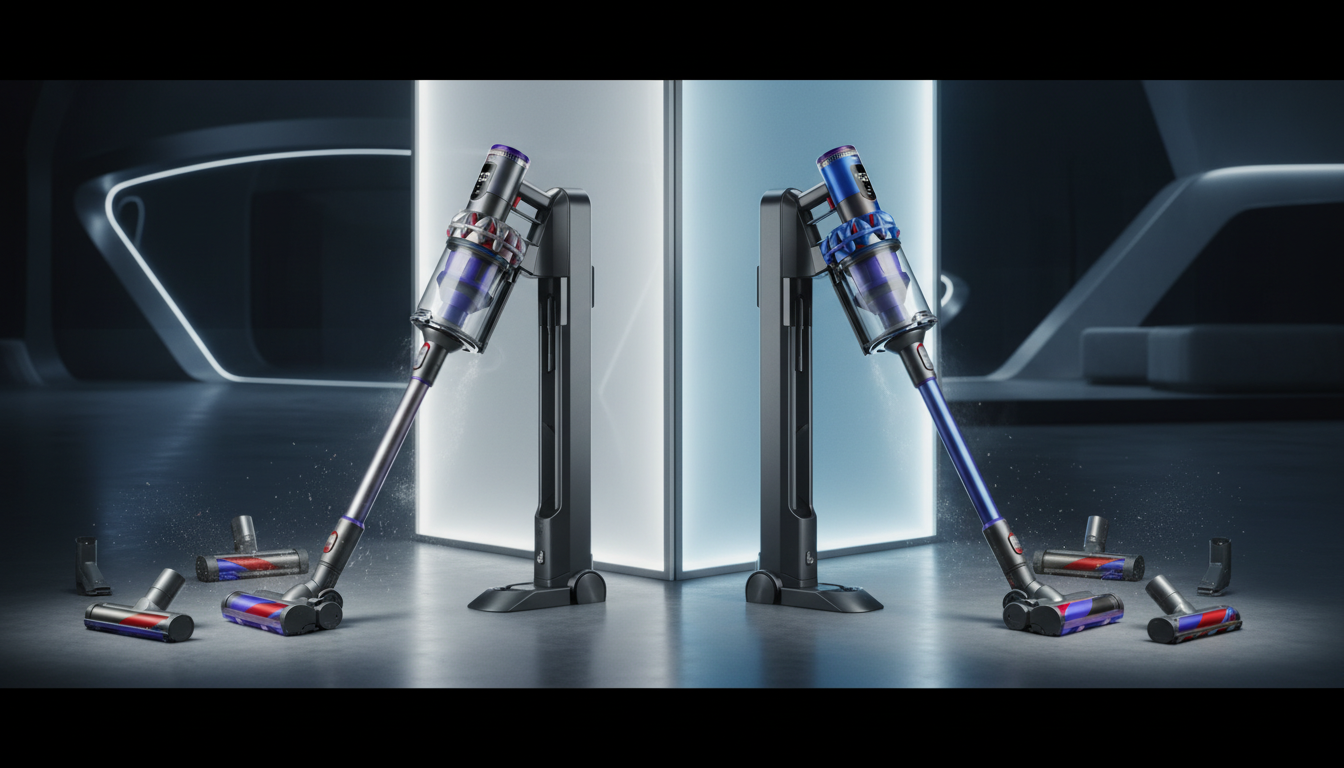
The Cordless Conundrum: Why the Dyson V8 vs V11 Debate Rages on in 2025
For over a decade, Dyson has dictated the rhythm of the floor-care industry. In 2025, the market is saturated with "smart" vacuums and laser-guided suction, yet two models remain the focal point of the savvy consumer's search: the Dyson V8 and the Dyson V11. This isn't just a matter of choosing an old model versus a new one; it is a fundamental choice between two different philosophies of engineering. The Dyson V8 represents the peak of "Essentialist Engineering"—a lightweight, reliable, and straightforward machine that revolutionized how we view cordless cleaning. Conversely, the V11 represents the dawn of "Intelligent Performance," introducing microprocessors and dynamic sensing that changed the vacuum from a dumb tool into a smart appliance.
The reason we are still discussing the dyson v8 vs v11 today is simple: value density. While the V15 and Gen5outsize have pushed the boundaries of suction power to nearly absurd levels, they have also pushed prices into the stratosphere. For the average homeowner in 2025, the V8 and V11 represent the "sweet spots" of the lineup. One offers the best entry-point into the Dyson ecosystem without the "cordless tax" being too high, while the other offers a professional-grade cleaning experience that rivals most upright corded vacuums.
Historically, the V8 was the machine that finally proved cordless could be your only vacuum. Before it, battery life was too short and suction was too weak. The V8 fixed that. Then came the V11, which addressed the remaining "anxiety" of cordless ownership—not knowing how much battery was left and having to manually switch modes for different floors. As we navigate the current landscape, the dyson v8 v11 difference has become a benchmark for determining what a household actually needs versus what is merely marketing fluff. Whether you are living in a compact city apartment or a sprawling suburban home with high-pile carpets and shedding pets, the choice between these two machines will define your cleaning efficiency for the next five to seven years. In this guide, we strip away the corporate jargon to give you the raw, technical, and practical truth about which machine deserves a spot in your utility closet.
The Critical Problem: The "Over-Engineering Trap" and Suction Fallacy
The most significant hurdle facing consumers in 2025 is what industry experts call the "Over-Engineering Trap." There is a pervasive myth in the vacuum industry that "more is always better." More air watts, more sensors, more digital displays. However, expert analysis of the dyson v8 vs v11 dynamic reveals a more nuanced reality. The critical problem isn't just about which vacuum is stronger; it's about the physiological and ergonomic cost of that power.
The Dyson V11 utilizes a much larger motor and a higher-capacity battery than the V8. This results in a massive jump in suction—from 115 Air Watts (AW) in the V8 to 185 AW in the V11. On paper, the V11 wins. But in practice, that extra power comes with a weight penalty. The V11 is significantly heavier and bulkier. For users with arthritis, smaller frames, or multi-level homes with many stairs, the V11 can become a literal burden. We see a recurring trend of "buyer's remorse" where users buy the V11 for its power but find themselves reaching for a lighter tool because the V11 is too cumbersome for quick spills. This is the dyson v8 v11 difference that many reviewers overlook: the trade-off between raw power and maneuverability.
Furthermore, there is the "Suction Fallacy." While 185 AW is impressive, 115 AW is already more than enough to lift fine dust, pet hair, and cereal from hard floors and low-pile rugs. If your home is 80% hardwood or tile, the extra 70 Air Watts of the V11 are essentially "dark power"—capacity you paid for but never actually utilize. The V11’s real advantage isn't just the power; it’s the management of that power. The V11 features a Dynamic Load Sensor (DLS) in the High Torque cleaner head, which adjusts motor speed 360 times per second based on floor resistance.
The critical problem for the 2025 buyer is determining their "Surface Profile." If you have thick, wall-to-wall carpeting, the V8 will struggle to agitate deep-seated grit that eventually grinds down carpet fibers. In this specific scenario, the V11 isn't a luxury; it’s a necessity for home maintenance. However, if you are a "lifestyle cleaner"—someone who does quick, frequent bursts of cleaning—the V8’s trigger-based system and lighter chassis are objectively superior. The V11 is a "marathon" machine designed for deep-cleaning sessions, while the V8 is a "sprinter." Choosing the marathon machine for a sprint (or vice versa) leads to mechanical inefficiency and user frustration. Understanding this distinction is the key to avoiding the over-engineering trap.
Methodology & Core Guide: The Technical Deep-Dive
To provide a definitive answer on the dyson v8 vs v11 debate, we analyzed these machines across five core pillars: Suction Architecture, Battery Chemistry, Filtration Integrity, Ergonomics, and Smart Features. Our methodology focuses on long-term ownership costs and real-world performance rather than laboratory "peak" numbers.
1. Suction Architecture and Motor Efficiency
The V8 is powered by the Dyson digital motor V8, spinning at 110,000 RPM. It uses a "Tier Radial" cyclone system (15 cyclones) to generate centrifugal force. It is a proven, reliable workhorse. The V11, however, uses the V11 motor which features a triple-diffuser to straighten airflow and reduce turbulence, spinning at 125,000 RPM.
- The Verdict: The V11 offers roughly 60% more suction power in "Boost" mode. If you have pets that shed heavily on rugs, the V11’s ability to pull hair out of carpet weave is significantly higher than the V8.
2. Battery Chemistry and Runtime
The dyson v8 v11 difference is perhaps most visible in the battery. The V8 uses a Nickel-Cobalt-Aluminum (NCA) battery providing up to 40 minutes of fade-free power (usually 25-30 with a motorized head). The V11 uses a larger, high-capacity 7-cell lithium-ion battery with cathodes made of nickel, cobalt, and aluminum.
- The Verdict: The V11 offers up to 60 minutes of runtime. More importantly, the V11’s battery is "swappable" (in later versions), meaning you can click in a fresh battery to double your cleaning time. The V8 battery is screwed in, making it a "repair task" rather than a "quick swap."
3. The LCD vs. LED Interface
The V8 is a "blind" machine. You have a small LED light that indicates roughly how much charge is left, but it’s a guessing game. The V11 features a high-definition LCD screen on the rear of the motor. This screen displays a countdown timer (down to the second) of remaining battery life in each mode.
- The Verdict: The LCD screen on the V11 is a game-changer for cleaning psychology. Knowing you have "4 minutes and 12 seconds" left prevents the frustration of the vacuum dying mid-room.
4. Dust Bin Capacity and Emptying Mechanism
The V8 has a bin capacity of 0.54 liters. The V11 (specifically the Torque Drive/Animal models) has a 0.76-liter bin. Both use the "point and shoot" hygienic emptying mechanism, which scrapes the shroud as you empty it.
- The Verdict: The V11 holds about 40% more debris. This means fewer trips to the trash can during a whole-house clean.
5. Cleaning Heads and Intelligence
The V8 usually comes with the Motorbar cleaner head. The V11 comes with the High Torque cleaner head. As mentioned, the V11’s head is "smart"—it senses the difference between a rug and a hard floor and adjusts the suction automatically.
- The Verdict: If you want a "set it and forget it" experience, the V11 is the winner. With the V8, you have to manually toggle the suction slide on the head and the power switch on the body.

dyson v8 vs v11 – BEST CHOICE
- High-quality product
- Customer favorite
- Best value option

dyson v8 vs v11 – RECOMMENDED
- High-quality product
- Customer favorite
- Best value option

dyson v8 vs v11 – BUDGET
- High-quality product
- Customer favorite
- Best value option
Expert Hacks & Maintenance: Maximizing Longevity
Owning a Dyson is like owning a high-performance vehicle; it requires specific maintenance to prevent performance degradation. Whether you choose the V8 or V11, these expert hacks will double the lifespan of your machine.
The "Cold Charge" Rule
The number one killer of Dyson batteries is heat. Never charge your vacuum immediately after a long cleaning session while the battery is still warm. Wait 15 minutes for the cells to cool down before plugging it in. This simple habit can extend your battery's usable life by two years.
Filter Hygiene: The 24-Hour Rule
Both models feature HEPA-grade filtration. Dyson recommends washing the filters once a month. However, the expert hack is the "24-Hour Dry." Never, under any circumstances, put a damp filter back into the machine. It will create a musty smell that is almost impossible to remove and can potentially damage the motor. Always have a spare filter on hand so you can rotate them.
Clearing the "Silent Blockage"
If your V8 or V11 starts pulsing (turning on and off rapidly), it’s not broken—it’s protecting itself. This usually indicates a blockage in the wand or the inlet. Check the "U-bend" of the cleaner head and the entry point of the bin. Use a flexible drain snake or a straightened coat hanger to clear debris from the wand.
Tool Optimization
Use the Mini Motorized Tool for mattresses and sofas. The main cleaner head is designed for floors and creates too much of a seal on soft fabrics, which can overheat the motor. For the V11, use "Auto" mode 90% of the time. "Boost" mode is only for extreme messes and will drain your battery in under 10 minutes.
Mega FAQ: Everything You Need to Know
1. Is the Dyson V11 much louder than the V8?
Surprisingly, no. While the V11 has a more powerful motor, it features better acoustic engineering. The sound profile is more of a "whir" than the V8's higher-pitched "whine," making it more tolerable for pets.
2. Can I use V11 tools on a V8?
Yes and no. Most non-powered tools (crevice tool, dusting brush) are interchangeable. However, the V11's High Torque cleaner head requires more power than the V8's battery can provide, so motorized heads are generally not cross-compatible.
3. Does the Dyson V8 still hold up for pet hair in 2025?
Yes, provided you use the Motorbar cleaner head which features de-tangling vanes. It won't deep-clean thick rugs as well as the V11, but for daily shedding on hard floors, it’s excellent.
4. How often should I replace the battery?
With average use, a Dyson battery typically lasts 3 to 5 years. If you notice your "Max" mode only lasts 30 seconds, it's time for a replacement.
5. Which one is better for stairs?
The V8. Because it is nearly 1.5 pounds lighter and has a smaller motor housing, it is much easier to maneuver on narrow treads.
6. Does the V11 really adjust suction automatically?
Yes, but only when using the High Torque or Digital Motorbar head in "Auto/Med" mode. It detects brush bar resistance to identify carpet vs. hard floors.
7. Is the V11 "Outsize" different from the V11?
Yes, the Outsize has a much larger bin and a wider cleaner head. It’s essentially a V11 on steroids for very large homes.
8. Can the V8 be used as a handheld?
Both the V8 and V11 are "2-in-1" machines. You can remove the wand to turn them into handhelds for car cleaning or furniture.
9. Why is the V8 cheaper in 2025?
The V8 uses older motor technology and lacks the LCD screen and smart sensors of the V11. It’s the "classic" model that Dyson keeps in production because of its popularity.
10. Does the V11 have a trigger lock?
Standard V11 models still require you to hold the trigger. However, some 2025 versions and aftermarket attachments offer a power button instead.
11. Is the V11 better for allergies?
Both have fully sealed HEPA filtration, but the V11’s higher suction can pull more allergens out of deep carpet piles.
12. Which one should I buy for a 1,500 sq. ft. home?
If the home is mostly hard floors, the V8 is sufficient. If it has significant carpet, the V11 is the better investment.
Closing Thoughts: The Final Verdict for 2025
The dyson v8 vs v11 debate ultimately comes down to your home's "Cleanliness Ecosystem." If you view a vacuum as a tool for quick intervention—cleaning up after a meal, dusting the baseboards, or a 10-minute sweep of the kitchen—the Dyson V8 is the superior choice. Its lightweight nature and lower price point make it the most logical "utility" vacuum ever made. It doesn't overcomplicate the task; it simply executes it.
However, if you are looking for a machine to replace your corded vacuum entirely, the Dyson V11 is the clear winner. The dyson v8 v11 difference in suction and battery intelligence is what allows the V11 to handle a 3-bedroom home with mixed flooring without breaking a sweat. The LCD screen removes the "range anxiety" of cordless cleaning, and the automatic suction adjustment ensures you aren't wasting battery on surfaces that don't need it.
In 2025, don't be swayed by the "latest and greatest" if your needs are modest. But don't under-equip yourself if you have high-traffic areas and deep-pile carpets. The V8 is the best vacuum for most people, but the V11 is the best vacuum for most homes. Choose the V8 for agility; choose the V11 for authority. Either way, you are investing in a lineage of engineering that remains the gold standard of the industry.