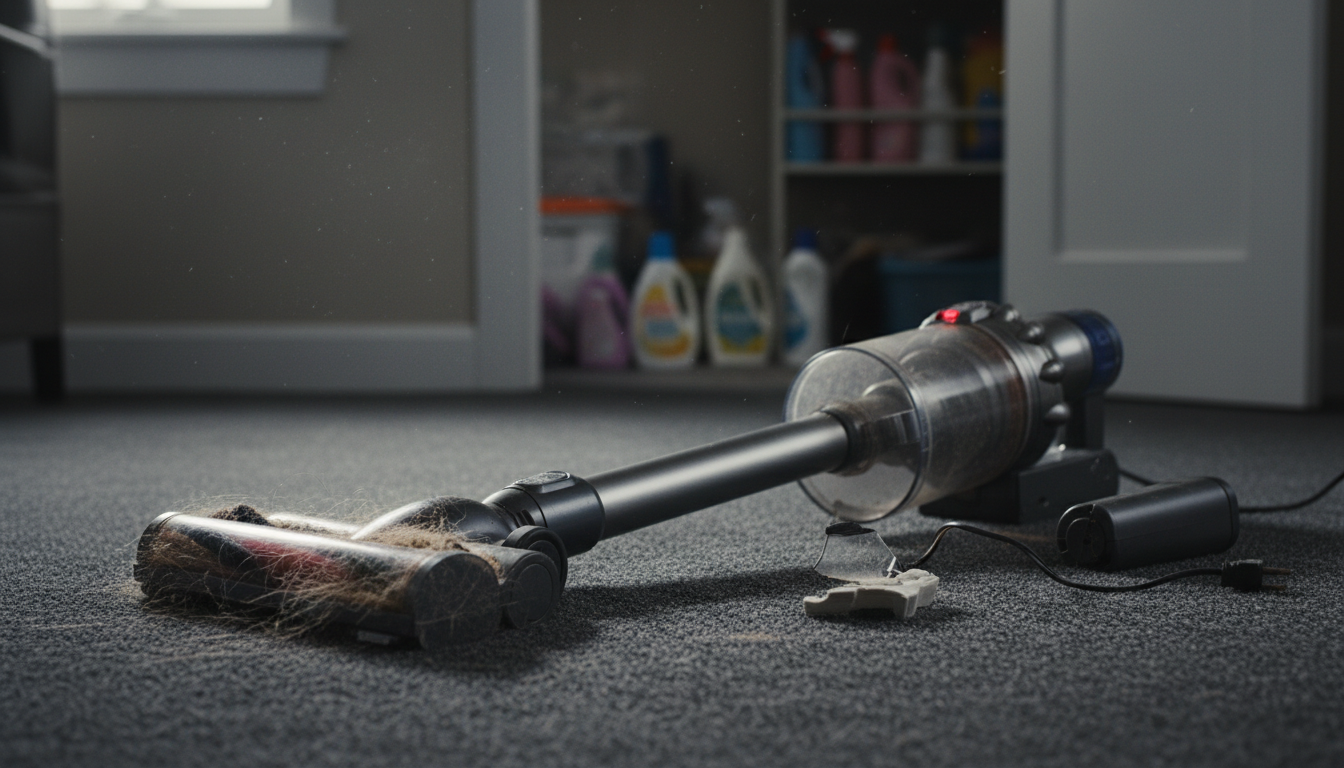
Understanding the Performance Plateau: Why Your Vacuum is Losing Power
It starts subtly. You notice a stray piece of lint that usually disappears in one pass remains stubbornly on the carpet. A week later, you realize the familiar roar of your machine has shifted to a higher, more strained pitch, or perhaps a hollow, wheezing sound. You aren't imagining it: your vacuum losing power is a tangible decline in mechanical efficiency that affects millions of households. When a high-end cleaning tool begins to underperform, most consumers jump to the conclusion that the motor is "burning out." In reality, the motor is often the most resilient part of the machine. The culprit behind a vacuum getting weaker is almost always a breach in the delicate balance of airflow physics.
To understand why a vacuum loses its edge, we must first view it not just as a "sucker of dirt," but as a sophisticated air-exchange system. A vacuum cleaner functions by creating a pressure differential. The motor spins a fan, which displaces air, creating a low-pressure zone inside the machine. Nature abhors a vacuum, so atmospheric air rushes in to fill that space, carrying debris with it. When your vacuum loses power, that pressure differential is being compromised. This guide is designed to move beyond the basic "empty the bag" advice. We are going to dissect the mechanical, pneumatic, and electrical reasons why your machine is failing you, and how you can restore it to factory-level performance.
The frustration of a weak vacuum isn't just about the extra time spent cleaning; it’s about the hidden costs. A vacuum with poor suction leaves behind microscopic allergens, dander, and fine dust that settle deep into carpet fibers, shortening the life of your flooring and potentially impacting indoor air quality. Furthermore, when a vacuum is "choked," the motor has to work significantly harder to move air, leading to overheating. This heat is the true enemy of longevity. By the time you finish this guide, you will have the diagnostic framework of a professional technician, allowing you to identify exactly where the "leak" or "blockage" resides in your specific model. Whether you own a high-tech cordless stick or a heavy-duty upright, the laws of physics remain the same. Let’s explore the critical mechanics of suction loss and how to reclaim your cleaning power.
The Critical Problem: The Physics of Airflow and Systemic Failure
When we talk about a vacuum losing power, we are usually talking about one of two things: a loss of "sealed suction" (the ability to lift heavy objects) or a loss of "airflow" (the volume of air moving through the system, measured in Cubic Feet per Minute or CFM). Most users experience a decline in CFM first. This is the "Critical Problem" of vacuum maintenance. Unlike a lightbulb that simply works or doesn't, a vacuum cleaner is a system of interconnected components where a 10% failure in one area can lead to a 50% loss in total cleaning efficacy.
The primary reason for a vacuum getting weaker is the accumulation of "micro-obstructions." Everyone knows to check for a sock stuck in the hose, but few look for the fine layer of silt that coats the interior of the corrugated tubing. This silt increases "wall friction," slowing down the air as it travels toward the motor. Imagine trying to breathe through a straw that is slowly being coated with honey on the inside; even if the hole is open, the effort required increases exponentially.
Furthermore, the filtration system is a double-edged sword. To protect the motor and your lungs, modern vacuums use HEPA and pre-motor filters. These filters are designed to catch particles as small as 0.3 microns. Over time, these pores become permanently "blinded." Even if you tap the filter out, the microscopic particles lodged deep within the synthetic fibers remain. This creates backpressure. Backpressure is the silent killer of suction. It forces the motor to spin at higher RPMs with less cooling air, which can eventually lead to the thermal cutoff switch tripping or the permanent warping of the fan blades (impellers).
Another overlooked critical failure point is the "Air Leak." A vacuum is a sealed system. Over years of use, the rubber gaskets that seal the dust bin to the motor housing, or the O-rings in the hose attachments, begin to dry out and crack. This is known as "parasitic air intake." Instead of pulling air from the floor nozzle where you need it, the vacuum begins pulling air from these tiny cracks near the motor. Because air follows the path of least resistance, a 2mm gap in a gasket can result in a massive drop in suction at the cleaning head. This is why a vacuum can feel like it has "strong suction" when you put your hand over the motor exhaust, but fails to pick up a single grain of rice from the floor. Understanding this distinction between motor power and systemic airflow is the first step in expert-level troubleshooting.
Methodology: The 5-Step Diagnostic Guide to Restoring Suction
If your vacuum is losing power, follow this professional methodology to isolate the cause. Do not skip steps; often, the problem is a combination of several minor issues rather than one major break.
1. The Airpath Integrity Check (The "Light Test")
The most common cause of a vacuum getting weaker is a physical obstruction in the primary airpath.
- The Hose: Detach the hose from both ends. Drop a heavy coin (like a quarter) through it. If the coin doesn't fall out the other side instantly, you have a partial blockage. Use a broom handle to gently push through the obstruction, but be careful not to puncture the hose walls.
- The Intake Port: Check the "elbow" where the hose connects to the vacuum body. This is a high-turbulence area where hair and pet fur often snag, creating a "nest" that traps larger debris.
- The Floor Head: Flip the vacuum over. Check the entrance to the suction channel. Debris often gets wedged right at the mouth of the intake.
2. Deep Filtration Analysis
Most people wash their filters, but they don't wash them correctly or often enough.
- Pre-Motor Filter: Usually a foam or felt disc. If it feels "crunchy" or looks gray/brown, it’s obstructing airflow. Wash with cold water only (no soap) and let it air dry for 24–48 hours. Never run a vacuum with a damp filter, as this will instantly ruin the motor.
- HEPA/Post-Motor Filter: These are often pleated paper. They generally cannot be washed unless explicitly stated by the manufacturer. If the white pleats have turned dark gray, the filter is "spent." A clogged HEPA filter is the #1 reason for a vacuum losing power in high-end brands like Dyson or Miele.
3. The Agitator and Brush Roll Resistance
A vacuum doesn't just suck; it "beats" the carpet to loosen dirt. If the brush roll is sluggish, the vacuum will feel like it has lost power.
- Hair Wrap: Use a seam ripper or scissors to remove hair, thread, and carpet fibers wrapped around the brush. This friction creates drag on the belt or motor.
- The Belt: In upright models, check the rubber drive belt. If it's loose, cracked, or "smells like burning rubber," it’s slipping. A slipping belt means the brush roll isn't spinning at the required 3,000+ RPM, leading to poor debris pickup.
4. Container and Bag Dynamics
- Bags: Change vacuum bags when they are 75% full. As the bag fills, the pores in the paper/fabric become blocked by fine dust, significantly reducing the surface area available for air to pass through.
- Cyclonic Bins: For bagless vacuums, the "cyclone" (the cone-shaped part inside the bin) must be clear. If fine dust builds up in the small holes of the shroud, the centrifugal force can't separate air from dust efficiently, leading to a massive drop in performance.
5. Seal and Gasket Inspection
Inspect every point where two parts of the vacuum click together. Look for worn foam seals or rubber gaskets. If you hear a high-pitched whistling sound while the vacuum is running, that is the sound of an air leak. You can often temporarily fix these with silicone sealant or by replacing the specific gasket.
Car Vacuum Cleaner Cordless, 4 in 1 Portable Vacuum Cleaner 16000PA High Power Air Duster & Air Blow
- High-quality product
- Customer favorite
- Best value option
Eureka Upright Vacuum Cleaner for Carpet and Hard Floor,Powerful Vacuum with Dual Cyclone Suction,Sw
- High-quality product
- Customer favorite
- Best value option
Cordless Vacuum Cleaner, 600W 50KPA Powerful Stick Vacuum with OLED Smart Display, 70Mins Runtime, S
- High-quality product
- Customer favorite
- Best value option
Expert Hacks & Advanced Maintenance
For those who have performed the basics but still find their vacuum losing power, these advanced maintenance hacks can provide the final 20% of performance recovery.
The Compressed Air Blowout
Even a clean-looking vacuum can have pounds of dust trapped in the motor housing. Take your vacuum to a garage or outside and use an air compressor (or canned air) to blow air backwards through the exhaust and into the motor vents. You will be shocked at the plume of dust that exits the machine. This fine dust often coats the motor's armature, causing it to run hot and slow.
Checking for Impeller Damage
The impeller is the fan that creates the suction. If you have ever vacuumed up a penny, a small rock, or a hard plastic toy, it may have "pitted" or chipped the blades of the fan. Even a small chip unbalances the fan, leading to vibration and a significant drop in the ability to move air. If your vacuum vibrates excessively or makes a "whirring" sound like a jet engine, the impeller likely needs replacement.
Restoring Hose Flexibility
Over time, vacuum hoses can become stiff or develop microscopic pinhole leaks. To check for leaks, run your hand along the hose while the vacuum is on; you will feel a cold "jet" of air hitting your skin if there is a hole. For stiff hoses that are causing the vacuum to tip over or lose suction at angles, a light coating of silicone spray on the exterior can restore flexibility and prevent further cracking.
Battery Health (For Cordless Models)
If you are using a cordless model and the vacuum is getting weaker, the problem might be electrical, not pneumatic. Lithium-ion batteries have a finite number of charge cycles. As they age, their "voltage sag" increases under load. This means the motor isn't getting the consistent current it needs to maintain high RPMs. If your vacuum runs for 5 minutes and then dies, or if "Max Power" mode causes it to shut down instantly, the battery pack needs to be replaced.
Mega FAQ: Expert Solutions for Suction Loss
1. Why does my vacuum lose power after only 10 minutes of use?
This is almost certainly a thermal issue. When airflow is restricted (due to clogged filters or a blockage), the motor overheats. To prevent a fire, the thermal cutoff switch kills the power. Once the motor cools down (usually 30–60 minutes), it will work again. Clean your filters immediately.
2. Can I use my vacuum without the HEPA filter to get more power?
Technically, yes, the airflow will increase significantly. However, you will be blowing fine dust and allergens directly back into the air, and you risk large particles entering the motor and destroying it. Never run a vacuum without its intended filtration.
3. My vacuum smells like it's burning. Is it dying?
A burning smell usually indicates one of two things: a slipping rubber belt (easy fix) or hair wrapped so tightly around the brush roll that the friction is melting the plastic or the hair itself. If the smell is "metallic/ozone," the motor brushes are likely sparking and the motor is failing.
4. Does the length of the hose affect suction power?
Yes. Physics dictates that the longer the hose, the more "friction loss" occurs. If you use a 20-foot extension hose on a standard vacuum, you will see a noticeable drop in power at the nozzle.
5. Why is my bagless vacuum losing power even though the bin is empty?
Check the "shroud"—the plastic screen inside the bin. Fine dust often coats this screen, preventing air from reaching the motor. Also, check the pre-motor filter located directly above or below the bin.
6. Can a "full" bag actually damage the motor?
Yes. A full bag restricts airflow. Since air is what cools the motor, a full bag causes the motor to run significantly hotter, which can melt internal plastic components or degrade the motor's copper windings.
7. How often should I realistically replace my vacuum filters?
For average households, foam filters should be washed every 3 months and replaced every year. HEPA filters should be replaced every 6–12 months, depending on pet ownership and allergy levels.
8. My vacuum is making a high-pitched whistling noise. What is it?
This is almost always an air leak. Check the gaskets where the hose meets the body and where the bin attaches. A whistle means air is being forced through a tiny gap at high speed.
9. Why does my cordless vacuum pulse on and off?
Pulsing is a safety feature (especially in Dyson models) that indicates a total blockage. The vacuum is trying to protect the motor from "deadheading" (running with zero airflow). Check the brush head and the intake for a solid clog.
10. Does vacuuming up baking soda or "carpet freshener" hurt the vacuum?
Yes! These powders are incredibly fine and will "blind" your filters almost instantly. They can also get into the motor bearings and cause premature failure. If you use them, you must clean your filters after every single use.
11. Can I wash my vacuum hose?
Yes, but only if it doesn't have electrical wires inside (for a powered brush head). Use warm soapy water, rinse thoroughly, and ensure it is 100% dry before reconnecting. Dampness in a hose will lead to mold and motor damage.
12. Is it worth repairing an old vacuum that has lost power?
If the vacuum was expensive ($300+), it is almost always worth a $20 set of filters and a $10 belt. If it’s a budget model and the motor is making a grinding noise, it is likely time for a replacement.
Closing Thoughts: Maintaining the Breath of Your Machine
A vacuum losing power is rarely a death sentence for the appliance; rather, it is a cry for maintenance. We live in a world where we expect our technology to work flawlessly without intervention, but a vacuum cleaner is a mechanical lung. It breathes in the grit of our lives and must exhale clean air to survive. By understanding the relationship between filtration, airpath integrity, and mechanical resistance, you can extend the life of your vacuum by years.
The key to a high-performing home is consistency. Don't wait for your vacuum to get weaker before you check the filters. Establish a quarterly "deep clean" routine: snip the hair from the brush roll, wash the foam filters, and check the hose for obstructions. Not only will your carpets look better and last longer, but you’ll also save hundreds of dollars in unnecessary replacement costs. Remember, suction is a privilege of physics—keep the air moving, and your vacuum will never let you down.